How to Use a Breville Espresso Machine: First Shots to Milk
To use a Breville espresso machine, fill the tank, let it heat, grind about 18 grams of coffee into the single-wall double basket, tamp it level, lock in the portafilter and press the 2 CUP button. Aim for a shot that takes 25 to 30 seconds, adjusting the grind size until it does. Then steam milk with the wand and wipe it straight away.
Key takeaways
- Use dual-wall baskets for pre-ground coffee and single-wall for fresh beans.
- The 1 CUP and 2 CUP buttons dispense preset volumes, which you can reprogram.
- Adjust the grind size until the shot takes 25 to 30 seconds.
- Flush the group and wipe the wand after every drink.
How to make espresso on a Breville machine: the short version
You will need: Breville espresso machine, fresh coffee beans or ground coffee, tamper and filter basket.
- Fill and heatFill the water tank, switch on and wait until the buttons stop flashing. Lock in the portafilter to warm it.
- Choose the basketUse the single-wall double basket for freshly ground beans, or the dual-wall basket for pre-ground coffee.
- Grind and doseGrind into the portafilter until the basket holds about 18 grams, or is slightly overfilled before tamping.
- Tamp and trimTamp firmly and level, and use the trimming tool if supplied to set the right height.
- BrewLock the portafilter in and press the 2 CUP button. The shot should take about 25 to 30 seconds.
- Steam milkPurge the wand, steam the milk until the pitcher is hot to the touch, then wipe and purge the wand.
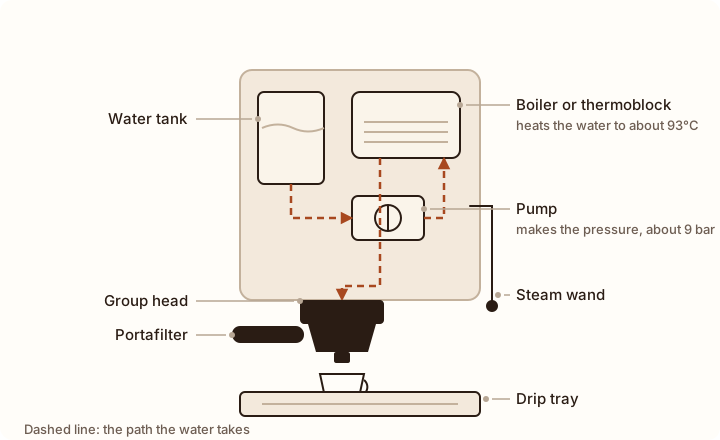
Breville’s home espresso machines share a common layout and logic, whether you have a Barista Express with its built-in grinder or a compact Bambino. Once you know the routine on one, the others are familiar. Your manual has the details for your model; this is the general workflow.
First-time setup
- Wash the tank, portafilter and baskets.
- Soak and fit the water filter if supplied.
- Fill the tank and switch on.
- Flush water through the group head and the steam wand.
- Test your water hardness with the supplied strip and set it in the machine if your model asks.
More in our setup guide.
Choosing the basket
| Basket | Use with |
|---|---|
| Single-wall, 2 cup | Fresh beans, for a double shot. The usual choice |
| Single-wall, 1 cup | Fresh beans, for a single |
| Dual-wall, 1 or 2 cup | Pre-ground coffee |
Dual-wall baskets have a single small hole underneath. See espresso filter baskets explained.
Making a shot
1. Warm up
Wait for the lights to stop flashing. Leave the portafilter locked in for a few minutes so it heats.
2. Grind
On machines with a grinder, set the grind size, push the portafilter into the cradle and release. The grinder runs for the time set on the grind amount dial. Hold the portafilter in for manual control.
For settings, see Breville espresso machine grind size.
3. Dose and tamp
Aim for about 18 grams in the double basket. Tap to settle the grounds, then tamp firmly and level. If your machine includes the trimming tool, use it to shave the coffee to the right height.
Models with assisted tamping do this step with a lever.
4. Brew
Wipe the basket rim, lock the portafilter in and press 2 CUP. Most Breville machines begin with a few seconds of low-pressure pre-infusion, then ramp up.
- On machines with a gauge, the needle should sit in the espresso range.
- The shot should take about 25 to 30 seconds.
Too fast: grind finer. Too slow: grind coarser. See how to dial in espresso.
5. Manual shots
Press and hold a cup button for manual pre-infusion, release to start full pressure, and press again to stop. This gives you control over shot length.
Steaming milk
- Fill the pitcher to below the spout.
- Purge the wand briefly.
- Manual wands: tip just under the surface, add air for a few seconds, then submerge slightly and let the milk spin. Stop when the pitcher is almost too hot to hold.
- Automatic wands: set milk temperature and foam level, place the pitcher on the sensor and press STEAM.
- Wipe the wand and lower it so it purges.
Technique in how to steam milk with an espresso machine.
Hot water
Machines with a hot water outlet can dispense water for americanos and for pre-warming cups.
Daily care
- Flush the group head after each shot.
- Wipe and purge the steam wand every time.
- Empty the drip tray when the indicator rises.
- Brush out the grinder chute weekly on models with a grinder.
When the machine asks for attention
- Clean Me: run the tablet cleaning cycle. See the Clean Me cleaning cycle.
- Descale: see how to descale a Breville Barista Express.
Common first-week problems
| Problem | See |
|---|---|
| Gauge stays low | Not reaching pressure |
| Grinder stops or jams | Grinder not working |
| Steam wand stops | Bambino Plus steam wand |
| Sour shots | Why is my espresso sour |
Still choosing a brand? See Breville vs De’Longhi.
For individual models, see our reviews of the Barista Touch Impress and the Oracle Jet. If you are thinking of buying used, see refurbished Breville espresso machines.
Frequently asked questions
Which filter basket should I use on a Breville?
Single-wall baskets for whole beans ground fresh on the machine or a capable grinder. Dual-wall baskets for pre-ground coffee. Each comes in one-cup and two-cup sizes.
How do I reprogram shot volume on a Breville?
Most models have a PROGRAM button. Press it, press the cup button you want to set to start the shot, and press that button again when you have the amount you want. Check your manual for your model.
How long does a Breville take to heat up?
Machines with a ThermoJet heater, such as the Bambino and Barista Pro, are ready in about three seconds. The Barista Express takes around a minute. All benefit from a few extra minutes to warm the portafilter.