How to Use a De'Longhi Espresso Machine (Stilosa, Dedica)
To use a De'Longhi pump espresso machine, fill the tank, switch on and wait for the ready light. Fit the right filter in the portafilter, add ground coffee and tamp lightly, lock it in and start the shot. Stop when you have about one ounce per shot. For milk, switch to steam, wait for the light and froth with the wand.
Key takeaways
- Prime the machine before first use by running water through the group and wand.
- The supplied filters are pressurized, so pre-ground espresso coffee works.
- On dial machines such as the Stilosa, you stop the shot yourself.
- After steaming, cool the boiler before brewing again.
How to make espresso on a De'Longhi pump machine: the short version
You will need: De'Longhi pump espresso machine, ground espresso coffee, tamper or scoop-tamper.
- Fill and heatFill the water tank, switch on and wait for the ready light, with the portafilter attached so it warms up.
- Fit the filter and add coffeePlace the one-cup or two-cup filter in the portafilter and fill it with ground coffee to just below the rim.
- TampPress the coffee down lightly and evenly, and wipe the rim clean.
- Lock in and brewAttach the portafilter, place a cup underneath and start the flow.
- Stop the shotStop when you have about one ounce for a single or two ounces for a double.
- Froth milkSelect steam, wait for the light, purge the wand, froth the milk, then wipe and purge again.
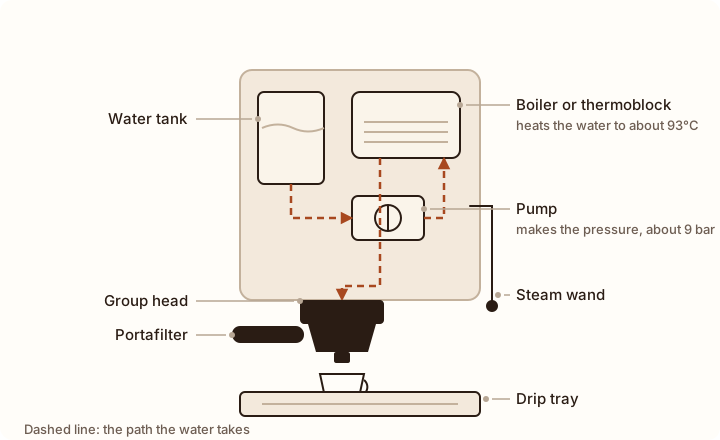
De’Longhi’s manual pump machines, from the budget Stilosa to the slim Dedica, are among the most common first espresso machines. They work on the same principles, with slightly different controls. Use this alongside the manual for your model.
Know your controls
Dial machines, such as the Stilosa. One selector knob with positions for on, coffee and steam, plus a separate steam knob. You start and stop the shot by turning the selector.
Button machines, such as the Dedica. Buttons for one cup, two cups and steam. The cup buttons dispense a preset amount and stop automatically. A dial on the side opens the steam wand.
Before first use
- Wash the tank, portafilter and filters.
- Fill the tank with fresh water.
- Switch on and wait for the ready light.
- Run about half a tank of water through the group head, then open the steam wand and run water through that.
This primes the pump and rinses the system. If no water comes out, see De’Longhi espresso machine not pumping water.
The filters
Most models come with:
| Filter | Use |
|---|---|
| One-cup | A single shot of ground coffee |
| Two-cup | A double shot |
| Pod filter | ESE paper pods, on some models |
These are pressurized filters. They are forgiving and designed for pre-ground coffee. More in espresso filter baskets explained.
Making a shot
- Heat up. Wait for the ready light with the portafilter attached. Give it a few more minutes if you can, and warm your cup.
- Fill the filter. One level scoop for the one-cup filter, two for the two-cup. Fill to just below the rim.
- Tamp lightly. Pressurized filters do not need force. Press evenly and wipe the rim.
- Lock in. Line up the handle, push up and turn right until firm.
- Brew. Turn the selector to the coffee position, or press a cup button.
- Stop. On dial machines, turn back when you have about 1 ounce for a single or 2 ounces for a double.
Frothing milk
- Select steam and wait for the ready light.
- Purge the wand into the drip tray for a couple of seconds.
- Fill a pitcher about a third with cold milk.
- Put the wand tip just under the surface and open the steam knob.
- Keep the tip near the surface for foam, then lower it to heat the rest.
- Close the steam knob before removing the pitcher.
- Wipe and purge the wand.
Many models have a wand sleeve with two positions, one for hot milk and one for cappuccino foam. Technique in how to steam milk with an espresso machine.
After steaming, cool down before brewing
The boiler is now too hot for coffee. Switch back from steam, open the steam knob and let water run into a jug until the lights show the machine is ready, or follow the cooling steps in your manual. Brewing straight away scalds the coffee.
Tip: pull your shot first, then steam the milk.
Daily care
- Empty and rinse the portafilter and filter.
- Wipe the steam wand and remove the sleeve to wash it.
- Empty the drip tray.
- Refill with fresh water.
Improving your results
- Use coffee ground for espresso, or grind fresh. See what coffee to use for espresso.
- Do not overfill the filter. It stops the portafilter sealing.
- Preheat everything.
- Descale on schedule. See how to descale a De’Longhi espresso machine.
Problems
| Problem | See |
|---|---|
| Lights flashing | De’Longhi Dedica lights flashing |
| Weak, watery coffee | Why is my espresso watery |
| Leaks around the handle | Portafilter leaking during a shot |
Still choosing a brand? See Breville vs De’Longhi.
For help choosing a model, see De’Longhi espresso machine reviews, the Linea Classic review and the All-in-One review.
Frequently asked questions
Do I need a special coffee for a De'Longhi espresso machine?
No. The standard filters are pressurized and work with supermarket coffee ground for espresso. Freshly ground beans taste better, but a fine drip grind is too coarse.
Why are the lights flashing on my De'Longhi?
Flashing usually means the machine is heating. Other patterns can indicate an empty tank, a descale reminder or that it needs to cool after steaming. Your manual lists the patterns for your model.
How long should I let the shot run?
About 25 to 30 seconds, giving roughly 1 ounce for a single or 2 ounces for a double. Letting it run much longer makes the espresso thin and bitter.