Espresso Filter Baskets: Pressurized vs Non-Pressurized
An espresso filter basket is the metal cup in the portafilter that holds the ground coffee. Pressurized, or dual-wall, baskets have a single exit hole and work with pre-ground coffee. Non-pressurized, or single-wall, baskets have many fine holes and need freshly ground coffee from a capable grinder, but produce better espresso.
Key takeaways
- Pressurized basket: forgiving, for pre-ground coffee or a basic grinder.
- Non-pressurized basket: needs a good grinder, gives real control and better flavor.
- Turn the basket over: one hole means pressurized, many holes means standard.
- Baskets are sized by diameter and by dose.
The filter basket is a small part that decides a great deal. Using the wrong type for your coffee is one of the most common reasons beginners get poor shots, and switching at the right time is one of the biggest upgrades available for a few dollars.
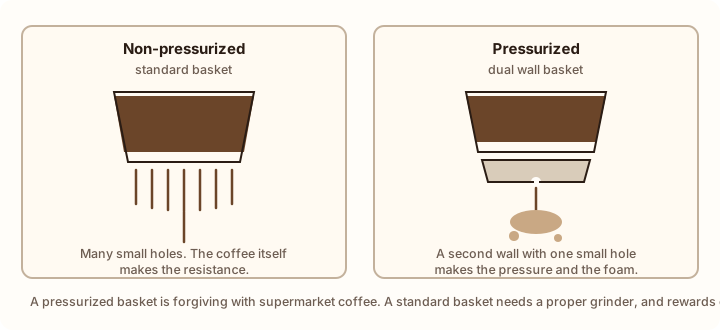
The two main types
Pressurized (dual-wall)
From above it looks normal. Underneath, the base is solid with a single tiny exit hole. Coffee passes through the inner layer of holes, collects in a space between two walls, and is forced through that one hole.
The basket itself creates the resistance. That means:
- It works with pre-ground coffee and uneven grinds.
- It produces a foam that resembles crema regardless of freshness.
- Tamping matters very little.
- You have little control over the result.
Non-pressurized (single-wall)
Hundreds of fine holes across the whole base. The coffee provides the resistance, so the grind has to be right.
- It requires a capable grinder and fresh beans.
- It responds to changes in grind, dose and tamp.
- It produces real crema and fuller flavor.
- It punishes mistakes.
Which should you use?
| Your setup | Basket |
|---|---|
| Pre-ground coffee | Pressurized |
| Blade grinder or basic drip grinder | Pressurized |
| Espresso-capable burr grinder, fresh beans | Non-pressurized |
| Built-in grinder on your machine, fresh beans | Non-pressurized |
Many machines include both. A typical path is to start with the pressurized basket and move to the standard one once you have a suitable grinder. See can you use regular coffee in an espresso machine.
Basket sizes
By diameter
Baskets must match the portafilter.
| Diameter | Common on |
|---|---|
| 58mm | Gaggia, Rancilio, most prosumer machines |
| 54mm | Breville Barista and Bambino lines |
| 51mm | Many De’Longhi and entry-level machines |
By dose
| Basket | Dose |
|---|---|
| Single | 7 to 10 g |
| Double | 16 to 18 g |
| Triple, or large double | 20 to 22 g |
Use the dose the basket is designed for. Underfilling gives soupy pucks and fast shots; overfilling stops the portafilter sealing. See how much coffee is in an espresso shot.
Single baskets are tapered and harder to get consistent results from. Most home users stick to the double.
Other baskets
- Blind basket: no holes at all. Used for backflushing when cleaning. See how to clean an espresso machine.
- Precision baskets: made with tighter tolerances and more uniform holes for even extraction.
- Pod or ESE baskets: shaped to hold pre-packed paper pods.
Ridged or ridgeless
Some baskets have a groove near the top that a spring in the portafilter clips into. Ridgeless baskets have smooth sides and come out more easily. It makes no difference to the coffee.
Looking after baskets
- Rinse after every shot and wipe dry.
- Soak weekly in hot water with espresso detergent.
- Hold it up to the light. If holes are blocked, scrub and soak again.
- Clear the exit hole on pressurized baskets with a pin if flow slows.
- Replace if dented or warped. A damaged rim causes leaks. See portafilter leaking during a shot.
Upgrading
Moving from a pressurized to a standard basket is worthwhile only alongside a suitable grinder. Without one, shots will run fast and taste sour. If you are ready, see the best budget espresso grinders and espresso grind size.
To watch how a basket is extracting, a naked portafilter helps; see the best bottomless portafilters.
Frequently asked questions
How do I know if my basket is pressurized?
Look at the underside. A pressurized basket has a single small hole, or a few, in the center of a solid base. A non-pressurized basket has hundreds of fine holes across the whole bottom.
Should I use a pressurized or non-pressurized basket?
Use pressurized if you have pre-ground coffee or a grinder that cannot grind fine and evenly. Use non-pressurized if you have a capable espresso grinder and fresh beans.
Do precision baskets make a difference?
A small one. Baskets with accurately made, evenly spaced holes can give a more even extraction. They are a refinement worth considering after the grinder and technique are sorted.
This article is part of our guide: Espresso Machine Accessories: The Ones Worth Buying