How to Dial In Espresso: A Step-by-Step Method
To dial in espresso, fix your dose (around 18 grams for a double), aim for twice that weight in the cup (about 36 grams), and adjust the grind until the shot takes 25 to 30 seconds. Then taste: if it is sour, grind finer or extend the shot; if it is bitter, grind coarser or shorten it.
Key takeaways
- Three numbers describe a shot: dose in, yield out, and time.
- Keep the dose fixed and change the grind first. Change one variable at a time.
- Time gets you close. Taste makes the final decision.
- Expect to re-dial for every new bag, and to nudge the grind finer as beans age.
How to dial in espresso: the short version
You will need: espresso machine and grinder, scale accurate to 0.1 g, timer, fresh coffee beans.
- Set the doseWeigh out the amount your basket is made for, usually 18 grams for a double, and keep it the same for every shot.
- Choose a target yieldStart with a 1:2 ratio, so 18 grams of coffee should give about 36 grams of espresso.
- Pull a shot and time itStart the timer with the pump and stop the shot when the scale reads your target yield.
- Adjust the grindIf the shot took under 25 seconds, grind finer. If it took over 30 seconds, grind coarser. Repeat until it lands in range.
- Taste and fine-tuneIf the shot is sour, grind slightly finer or let it run longer. If it is bitter, grind slightly coarser or stop it sooner.
- Write down the recipeNote the dose, yield, time and grinder setting so you can repeat it.
Dialing in sounds technical, and people often treat it as a dark art. It is a short, logical routine. You hold most things still, change one thing at a time, and let the timer and your taste tell you which way to go.
Once you have done it a few times, a new bag takes ten minutes.
The three numbers
Every espresso recipe comes down to three measurements.
- Dose: the weight of dry coffee in the basket.
- Yield: the weight of liquid espresso in the cup.
- Time: how long the shot takes, from starting the pump to stopping it.
A typical starting recipe is written as 18 g in, 36 g out, 25 to 30 seconds.
You need a scale that reads to a tenth of a gram and a timer. Measuring by eye or by volume does not work well, because crema makes a shot look bigger than it is.
Step 1: fix the dose
Use the amount your basket is designed for. Most double baskets take 16 to 20 grams, and 18 is the usual place to start. Then leave it alone. The dose is your anchor, and changing it at the same time as the grind makes results impossible to read.
Step 2: choose a yield
Start at a 1:2 ratio. For 18 grams of coffee, aim for 36 grams of espresso. Put the cup on the scale under the portafilter so you can stop at the right moment.
Step 3: pull a shot and time it
Prepare the puck the same way every time: distribute the grounds evenly and tamp level, as described in how to tamp espresso. Start the timer as you start the pump. Stop the shot when the scale reads 36 grams.
Step 4: adjust the grind using the time
| Shot time | What it means | What to do |
|---|---|---|
| Under 20 seconds | Far too coarse | Grind noticeably finer |
| 20 to 25 seconds | Slightly coarse | Grind a little finer |
| 25 to 30 seconds | In range | Taste it |
| 30 to 35 seconds | Slightly fine | Grind a little coarser |
| Over 35 seconds | Far too fine | Grind noticeably coarser |
After each change, grind and throw away a few grams. The first coffee out of the grinder is still at the old setting. More on adjustment in our guide to espresso grind size.
Step 5: taste, then fine-tune
The 25 to 30 second window is a guide. The real target is a shot that tastes balanced: some sweetness, some acidity and a pleasant bitterness, with none of them dominating.
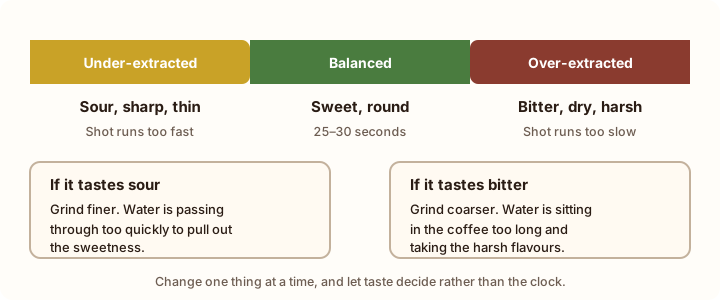
- Sour, sharp or thin: under-extracted. Grind a touch finer, or keep the grind and let the shot run a few grams longer.
- Bitter, harsh or drying: over-extracted. Grind a touch coarser, or stop the shot a few grams sooner.
- Sour and bitter at once: usually channeling. Look at your puck preparation before touching the grind.
For a fuller list of causes, see why is my espresso sour and why is my espresso bitter.
Step 6: write it down
Note the coffee, dose, yield, time and grinder setting. Next time you buy that coffee you will start close, and over a few bags you will learn how your grinder responds.
Adjusting the ratio for the roast
The 1:2 starting point suits medium roasts. Other roasts often taste better with a different yield.
| Roast | Ratio to try | Why |
|---|---|---|
| Dark | 1:1.5 to 1:2 | Extracts easily; a shorter shot avoids bitterness |
| Medium | 1:2 | The standard |
| Light | 1:2.5 to 1:3 | Harder to extract; more water brings out sweetness |
When you need to dial in again
- A new bag, even of the same coffee. Roast batches differ.
- As beans age. Over a few weeks the same setting runs faster, so you gradually go finer.
- A change of roast level or origin.
- A big change in weather. Humidity affects how coffee grinds.
- After cleaning or adjusting the grinder.
Small daily drift is normal. One click finer every few days as a bag gets older is typical.
Common mistakes
- Changing two things at once. You will not know which one made the difference.
- Judging by time alone. A 28-second shot can still taste wrong.
- Chasing a number from the internet. Someone else’s grinder setting means nothing on yours.
- Using stale beans. Coffee past its best cannot be dialed in to taste good. See why there is no crema on your espresso for the signs.
- Skipping the warm-up. A cold machine gives sour shots that no grind change will fix.
If you cannot get it into range
If one grinder step takes you from too fast to too slow, the grinder’s steps are too wide for espresso. You can work around it a little by changing the dose by half a gram. The lasting fix is a grinder with finer adjustment, which we cover in the best budget espresso grinders.
Dialing in depends on weighing every shot, so a scale that fits your drip tray matters. See best espresso scales.
If you want the brewing sequence itself broken down, see how to pull an espresso shot.
Frequently asked questions
What does dialing in espresso mean?
It means adjusting your recipe, mainly the grind size, until a particular coffee tastes its best on your equipment. Each coffee needs its own settings, so the process is repeated whenever you open a new bag.
How many shots does it take to dial in?
Usually three to five for a new coffee. If you only changed bags of the same coffee, one or two small adjustments are often enough.
What is the best espresso ratio?
A 1:2 ratio of dry coffee to liquid espresso is the standard starting point. Darker roasts often taste better a little shorter, around 1:1.5, and lighter roasts a little longer, around 1:2.5.
Do I need a scale to dial in espresso?
It makes the job far easier. Without one you cannot tell whether a change in taste came from the grind or from using more or less coffee. An inexpensive scale that reads to 0.1 gram is enough.