Why Is My Espresso Sour? 6 Causes and How to Fix Each
Sour espresso is under-extracted: the water passed through the coffee too quickly or too cool to dissolve the sweeter compounds that balance the acids. The most common cause is a grind that is too coarse. Grind finer so the shot takes 25 to 30 seconds, and make sure the machine and portafilter are fully heated.
Key takeaways
- Sour means under-extracted. Bitter means over-extracted. They need opposite fixes.
- Check the shot time first. Under 20 seconds for a double almost always means grind finer.
- A cold machine or cold portafilter makes sour shots even when the grind is right.
- Light roasts are naturally more acidic and harder to extract.
A sour shot is unmistakable: sharp, lemony, mouth-puckering, and often thin. It is also the most common complaint from people new to espresso, and it has one main explanation.
Sour espresso is under-extracted. Coffee gives up its flavors in a rough order. Acids dissolve first, sugars and richer compounds come next, and bitter compounds come last. If the water does not have enough time or heat to get past the first stage, you taste mostly acid.
So the job is to extract more. Here are the causes, in the order worth checking.
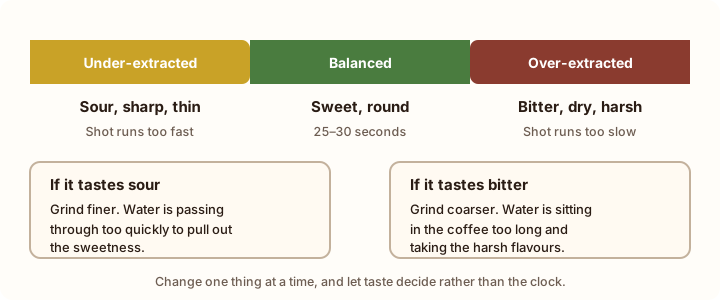
First: is it sour or bitter?
People mix these up constantly, and the fixes are opposite.
| Sour | Bitter | |
|---|---|---|
| Tastes like | Lemon, unripe fruit, vinegar | Burnt toast, ash, strong black tea |
| Where you feel it | Sides of the tongue | Back of the tongue and throat |
| Aftertaste | Short, sharp | Long, dry |
| Cause | Under-extraction | Over-extraction |
If yours is actually bitter, see why is my espresso bitter.
1. The grind is too coarse
This is the cause in most cases. When the grounds are too coarse, water finds its way through quickly and the shot is over in 10 to 15 seconds.
How to tell: time the shot. A double that finishes in under 20 seconds, or gushes out pale and watery, is too coarse.
Fix: grind finer in small steps until about 18 grams of coffee gives about 36 grams of espresso in 25 to 30 seconds. Our guide to espresso grind size walks through the process.
2. The machine is not hot enough
Cool water extracts poorly. Even when the boiler is at temperature, a cold group head and portafilter pull heat out of the water in the last few centimeters.
How to tell: the first shot of the day is sour and later ones are better.
Fix: let the machine warm up fully with the portafilter locked in. Thermoblock machines need a few minutes despite being “ready” in seconds; machines with boilers need 15 to 30 minutes. Running a blank shot through the empty portafilter just before brewing also helps. If your machine has adjustable temperature, raise it a degree or two.
3. The shot is too short
If you stop the shot early, you keep the acidic first part and miss the sweeter part that follows.
How to tell: the timing is fine, but you are getting much less liquid than twice the weight of the dry coffee.
Fix: let the shot run longer. If you are stopping at 25 grams from an 18 gram dose, try 36 to 40 grams.
4. Not enough coffee in the basket
Too little coffee leaves a gap above the puck and offers less resistance, so the water moves through faster.
How to tell: the used puck is soupy, and a coin placed on the tamped coffee sits well below the rim.
Fix: weigh your dose. Use the amount your basket is designed for, typically 16 to 20 grams for a double.
5. Channeling
If the coffee is unevenly distributed or tamped at an angle, water punches a path through the weakest spot. That part of the puck is over-extracted and the rest barely touched, giving a shot that is sour and sometimes bitter as well.
How to tell: the stream spurts or sprays, starts off to one side, or the used puck has small holes in it.
Fix: break up clumps and level the grounds before tamping, then press straight down. See how to tamp espresso.
6. The beans
Sometimes the coffee itself is the reason.
- Light roasts keep more of their natural acidity and are denser, so they are harder to extract. They need a finer grind, hotter water and often a longer shot. Some brightness is intended and will not go away.
- Very fresh beans, within a few days of roasting, hold a lot of carbon dioxide, which interferes with extraction and adds a sharp edge. Most espresso tastes best from about one to four weeks after the roast date.
Fix: if you want a rounder, sweeter shot with less effort, try a medium or medium-dark roast.
What to change, in order
Work through one change at a time so you know which one helped.
- Confirm the machine and portafilter are fully heated.
- Weigh the dose.
- Grind finer until the shot takes 25 to 30 seconds.
- If it is still sour, let the shot run a little longer.
- If it is still sour, raise the temperature if you can, or try a darker roast.
When the machine is the limit
Some entry-level machines brew cooler than ideal and cannot be adjusted. On those, the practical options are a longer warm-up, a blank shot before brewing and a darker roast. A machine with stable, adjustable temperature makes this problem much easier to solve; we explain why in how an espresso machine works.
Frequently asked questions
Is sour espresso the same as bitter espresso?
No, and the fixes are opposite. Sour is a sharp, lemony taste felt on the sides of the tongue, caused by under-extraction. Bitter is a harsh, dry taste at the back of the mouth, caused by over-extraction.
Should I grind finer or coarser if my espresso is sour?
Finer. A finer grind slows the water down and gives it more time to extract the sugars and heavier compounds that balance the acidity.
Why is my espresso sour even though the shot time is right?
Look at temperature and yield. A machine or portafilter that has not fully warmed up brews too cool. Stopping the shot too early also leaves it sour, so try letting it run a few grams longer.
Can the beans make espresso sour?
Yes. Light roasts keep more of their natural acids and need a finer grind and hotter water. Beans used within a few days of roasting can also taste sharp because they are still releasing a lot of gas.