How Does an Espresso Machine Work? A Plain Walkthrough
An espresso machine heats water to roughly 195–205°F, then a pump pushes it through a tightly packed puck of finely ground coffee at about 9 bars of pressure. That pressure extracts a small, concentrated shot in around 25 to 30 seconds. Everything else on the machine exists to keep temperature and pressure steady.
Key takeaways
- Four parts do the real work: the pump, the heating system, the group head and the portafilter.
- Around 9 bars at the coffee is the target. A box that says 15 or 20 bars is describing the pump's maximum, not what brews your shot.
- The heating system (thermoblock, single boiler, heat exchanger or dual boiler) is the biggest difference between a $200 machine and a $2,000 one.
- Most bad shots come from grind size and dose, not from the machine.
Press the button on an espresso machine and about half a minute later you have a shot. It looks like a simple job, but the machine is juggling two things that fight each other: water hot enough to extract coffee properly, and enough pressure to force that water through grounds packed almost as tight as a hockey puck.
Once you know which part handles which job, most of the confusing spec sheets start to make sense. So does the price gap between machines.
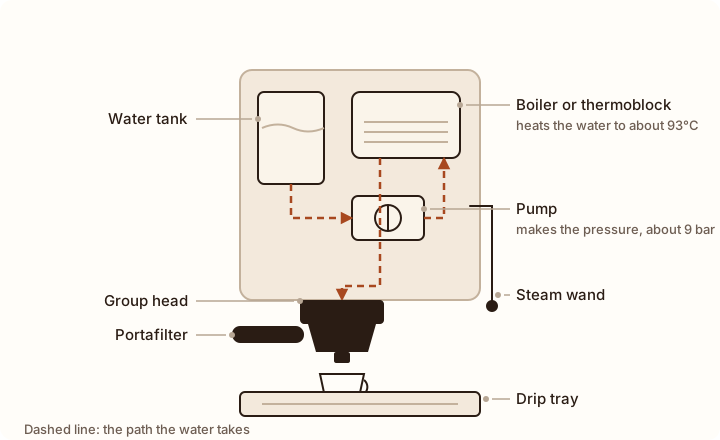
The short path water takes
Every pump-driven espresso machine moves water through the same five stops:
- Reservoir. Cold water sits in a removable tank, or comes straight from a water line on plumbed machines.
- Pump. It pulls water from the tank and pressurizes it.
- Heating system. A boiler or thermoblock brings the water up to brewing temperature.
- Group head. This heavy metal block spreads the hot water evenly over the coffee.
- Portafilter. The handle you lock in. Its basket holds the ground coffee, and the espresso drips out the bottom.
That is the whole machine. The rest is control: valves, thermostats and sensors that keep those five stops consistent from one shot to the next.
The pump: where the pressure comes from
Home machines use one of two pump types.
A vibratory pump is a small piston pushed back and forth by an electromagnet, dozens of times a second. It is cheap, compact and easy to replace, which is why you will find one in almost every machine under $1,500. It is also the source of that familiar buzzing sound.
A rotary pump uses a spinning vane driven by a motor. It is quieter, builds pressure more smoothly and can be connected to a water line. You pay for it, and it mostly shows up on prosumer machines.
Either type can make excellent espresso. What matters more is the number that reaches the coffee, which brings us to the most misunderstood figure on the box.
Why “15 bar” and “20 bar” do not mean better coffee
Espresso is brewed at around 9 bars, roughly nine times atmospheric pressure. A pump rated for 15 or 20 bars can produce that much against a blocked outlet, but good machines include an over-pressure valve that bleeds off the excess so the coffee sees something close to 9.
So a 20 bar machine is not twice as good as a 9 bar one. On cheaper machines without a properly set valve, the extra pressure can actually make shots harsher.
The heating system: the part you are really paying for
This is where machines differ the most, and where your money goes.
| Heating system | How it works | What it means for you |
|---|---|---|
| Thermoblock or thermocoil | Water is flash-heated as it passes through a heated metal channel | Ready in under a minute; less heat stability on back-to-back shots |
| Single boiler | One small tank of water, heated to brewing or steaming temperature | Steady brew temperature; you wait between pulling a shot and steaming milk |
| Heat exchanger | One steam-temperature boiler with a tube running through it that heats brew water on the way past | Brew and steam at once; needs a short flush to settle the temperature |
| Dual boiler | Separate boilers for brewing and steaming | Brew and steam at once with precise control; biggest and most expensive |
If you mostly drink straight espresso, a single boiler or thermoblock is plenty. If you make several milk drinks in a row, the wait on a single boiler gets old quickly, and that is the point where a heat exchanger or dual boiler earns its price.
Many machines add a PID controller, a small digital thermostat that holds the temperature within a degree or so. Older machines use a simple mechanical thermostat that lets the temperature swing by several degrees, which is one reason two shots in a row can taste different.
The group head and portafilter: where coffee meets water
The group head has two jobs. It locks the portafilter in place with a rubber gasket so pressure cannot escape, and it spreads water across the coffee through a perforated metal disc called the shower screen.
It is also a big lump of metal, and that is deliberate. A hot, heavy group head keeps the water from cooling down in the last inch of its journey. This is why the standard advice is to leave the portafilter locked in while the machine warms up.
Portafilters come in a few sizes. Most prosumer and commercial machines use 58mm; many Breville machines use 54mm; some budget machines use 51mm. Size does not decide quality, but 58mm gives you the widest choice of baskets, tampers and other accessories later on.
What happens during the shot
When you start a shot, the pump pushes hot water into the space above the coffee. The puck resists, pressure builds, and water is forced through the grounds, dissolving oils and flavor compounds as it goes.
The grind does most of the regulating here. Too coarse and the water rushes through in ten seconds, giving you a thin, sour shot. Too fine and it chokes, dripping out slowly and tasting bitter. A good starting point is roughly twice the weight of liquid out as dry coffee in, in 25 to 30 seconds.
When you stop the shot, most machines open a three-way solenoid valve that releases the leftover pressure into the drip tray. That is the short hiss you hear, and it is why the used puck comes out dry and firm instead of soupy.
How the steam wand works
Steam needs water well above boiling point, held under pressure. Open the steam valve and that pressure sends steam out through the tip of the wand, where it heats the milk and folds in air to create foam.
A dedicated steam boiler gives you strong, continuous steam. A thermoblock makes steam on demand, which works but takes longer to texture a full pitcher.
What this means when you are shopping
A few things follow from all of this:
- Ignore the bar rating. Look for stable temperature and a real over-pressure valve instead.
- Match the heating system to what you drink. Milk drinks for several people point toward a heat exchanger or dual boiler.
- Budget for a grinder. A capable grinder paired with a modest machine beats an expensive machine paired with pre-ground coffee.
- Plan for maintenance. Scale from hard water is the most common reason machines fail early. Knowing how to descale an espresso machine is part of owning one.
If you are ready to compare specific models, our guide to the best espresso machines under $1,000 applies everything above to the machines most people shortlist.
Frequently asked questions
How many bars of pressure does espresso need?
About 9 bars at the coffee puck is the long-standing standard. Machines advertised with 15 or 20 bar pumps are quoting the pump's maximum output; a valve inside usually limits what actually reaches the coffee.
What temperature does an espresso machine brew at?
Most machines aim for water between 195 and 205°F (90 to 96°C) at the group head. Lighter roasts tend to taste better toward the hotter end, darker roasts toward the cooler end.
Why does my espresso machine need to warm up?
The water heats quickly, but the metal group head and portafilter take longer. If they are cold they pull heat out of the water and the shot tastes sour. Thermoblock machines are ready in under a minute; machines with large boilers and heavy group heads can need 15 to 30 minutes.
Is steam made by the same part that heats brewing water?
It depends on the machine. Single-boiler and thermoblock machines use one heater and switch between brewing and steaming temperatures. Heat exchanger and dual boiler machines can brew and steam at the same time.