How to Make Espresso Without a Machine: 3 Methods That Work
You cannot make true espresso without a machine, because espresso needs about 9 bars of pressure. You can make strong, concentrated coffee that works well in lattes and other espresso drinks. A moka pot comes closest, an AeroPress is the most flexible, and a French press works if it is all you have.
Key takeaways
- True espresso requires high pressure. These methods make espresso-style coffee, which is close enough for milk drinks.
- Moka pot: the richest, most espresso-like result without a machine.
- AeroPress: clean and strong, with the most control.
- French press: the weakest of the three, but better than nothing.
How to make espresso-style coffee with a moka pot: the short version
You will need: moka pot, finely ground coffee, hot water.
- Fill the base with hot waterPour pre-heated water into the bottom chamber up to the safety valve, not above it.
- Add the coffeeFill the filter basket with fine to medium-fine grounds and level it off. Do not tamp.
- Assemble and heatScrew the top on firmly, using a towel to hold the hot base, and place the pot on medium-low heat with the lid open.
- Watch the flowCoffee will begin to flow steadily into the top chamber. Keep the heat low so it does not spurt.
- Stop the brewWhen the stream turns pale and starts to sputter, take the pot off the heat and cool the base under running water.
- Serve immediatelyPour straight away and use the coffee as you would a shot of espresso.
A straight answer first: none of the methods below make real espresso. Espresso means coffee brewed under roughly 9 bars of pressure, and only a machine with a pump or a lever can produce that. We explain why in what espresso is.
What you can make at home with ordinary equipment is strong, concentrated coffee that behaves like espresso in a latte, cappuccino or iced drink. For most people, that is the actual goal.
Here are three ways to do it, starting with the best.
What you need for any of these
- Dark or medium-dark roast coffee. It gives the deeper, less acidic flavor people associate with espresso.
- Freshly ground coffee, if possible. If you do not own a grinder, see how to grind coffee beans without a grinder.
- A kitchen scale. Measuring by weight makes results repeatable. Tablespoon measures are given as a fallback.
Method 1: Moka pot (the closest match)
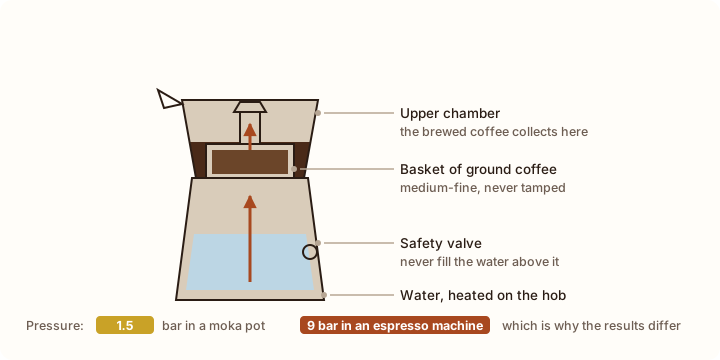
A moka pot is the classic Italian stovetop brewer. Water in the sealed base boils, and the steam pressure pushes it up through a basket of coffee into the top chamber. That pressure is only 1 to 2 bars, but it is enough to produce a strong, heavy-bodied coffee.
You need: a moka pot and fine to medium-fine coffee, slightly coarser than espresso grind.
- Fill the base with hot water up to the safety valve. Starting with hot water stops the coffee from cooking on the stove while the pot heats.
- Fill the basket with coffee and level it off with a finger. Do not tamp. Packed coffee can block the flow.
- Screw the top on firmly. The base is hot, so hold it with a towel.
- Heat on medium-low with the lid open. After a few minutes coffee will start to flow into the top.
- Take it off the heat when the stream turns pale and sputters. Run the base under cold water to stop the brew. This prevents bitterness.
- Pour immediately.
Result: strong, rich and slightly bitter in a good way, with no real crema. A three-cup moka pot gives about the same amount as two double shots.
Method 2: AeroPress (the most control)
The AeroPress is a plastic plunger brewer. Pressing by hand creates a little pressure, well under 1 bar, and its paper filter gives a clean cup. Brewed with less water than usual, it makes a good concentrate.
You need: an AeroPress, fine coffee and water just off the boil.
- Put a paper filter in the cap, rinse it and attach the cap. Stand the AeroPress on a sturdy mug.
- Add 18 grams of fine coffee, about two rounded tablespoons.
- Pour in about 60 grams of hot water, roughly a quarter cup.
- Stir for 10 seconds, then insert the plunger and wait 30 seconds.
- Press down firmly and steadily for 20 to 30 seconds until you hear a hiss.
Result: about one double shot’s worth of clean, strong coffee. It is less heavy than moka pot coffee and has less bitterness. If you want more texture, a metal filter lets more oils through.
Method 3: French press (if it is all you have)
A French press uses no pressure at all, so this is the furthest from espresso. You can still get a strong brew by using much more coffee than usual.
You need: a French press and medium-coarse coffee.
- Add 30 grams of coffee, about four tablespoons.
- Pour in 200 grams of water just off the boil, a little under a cup. That is roughly double the usual strength.
- Stir, put the lid on with the plunger up, and wait four minutes.
- Press slowly and pour everything out right away, so it does not keep brewing.
Result: strong and full-bodied, but thinner than the other two and with some sediment. It works in a milk drink. Drunk straight, it tastes like strong coffee, not espresso.
How the three compare
| Moka pot | AeroPress | French press | |
|---|---|---|---|
| Pressure | About 1 to 2 bars | Under 1 bar | None |
| Closest to espresso | Yes | Fairly | Least |
| Body | Heavy | Medium, clean | Full, with sediment |
| Difficulty | Easy with practice | Easy | Very easy |
| Best for | Lattes, cappuccinos | Americanos, iced drinks | When you have nothing else |
Frothing milk without a steam wand
Heat milk to steaming, not boiling, on the stove or in the microwave. Then use any of these:
- A handheld frother, which is cheap and fast.
- A French press: pour in the warm milk and pump the plunger up and down for 20 seconds.
- A jar: shake cold milk in a sealed jar for 30 seconds, remove the lid and microwave for 30 seconds.
What about a Keurig or other pod machine?
A Keurig brews at low pressure, so its “espresso” pods make strong coffee, not espresso. We cover that in can a Keurig make espresso.
When it is worth buying a machine
If you make espresso-style drinks most days, a machine pays off in convenience and in flavor. Real espresso has a sweetness and texture these methods cannot reach. Entry-level machines are more affordable and more forgiving than they used to be. Our guide to the best espresso machines under $1,000 is a sensible place to start, and how an espresso machine works explains what you would be paying for.
A drip brewer is a different case; see can you make espresso in a regular coffee maker.
Frequently asked questions
Can you make real espresso without a machine?
Not true espresso. Espresso is defined by brewing at roughly 9 bars of pressure, and a moka pot, AeroPress or French press cannot reach that. They make concentrated coffee that substitutes well in most recipes.
What is the closest thing to espresso without a machine?
A moka pot. It uses steam pressure of about 1 to 2 bars to push water through fine coffee, producing a strong, heavy-bodied brew that is the nearest match in flavor.
Can I use regular coffee to make espresso without a machine?
Yes. Any beans work. A darker roast gives a more espresso-like flavor, and the coffee should be ground finer than for drip: fine for a moka pot and AeroPress, medium-coarse for a French press.
Can I make a latte without an espresso machine?
Yes. Brew a strong concentrate with a moka pot or AeroPress, heat milk on the stove or in a microwave, and froth it with a handheld frother or by shaking it in a sealed jar before heating.